


Recent works
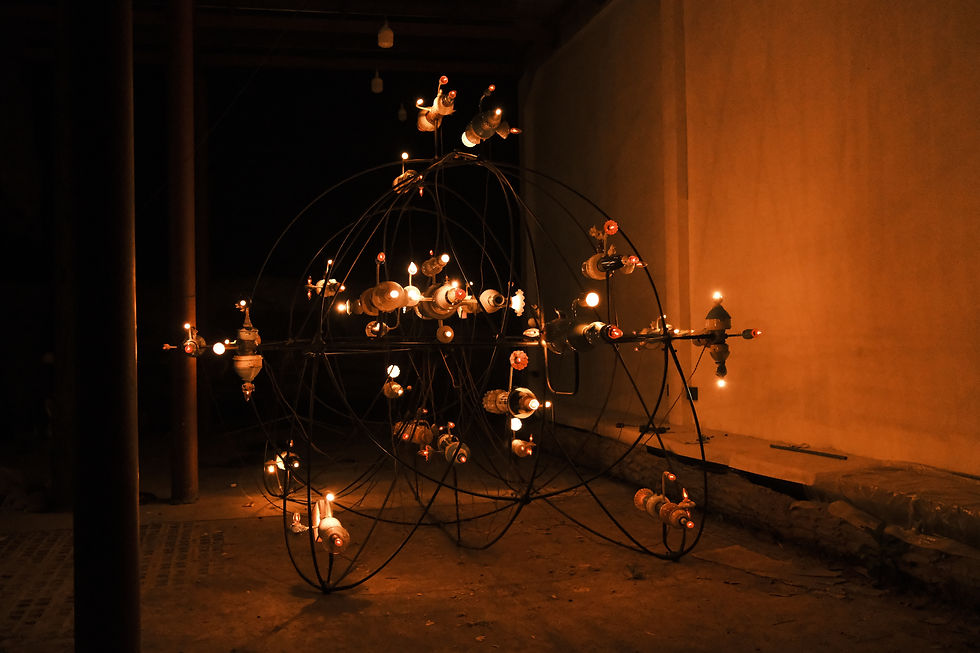
The Spirits of Maritime Crossing, Venice Art Biennale
Palazzo Rocca Contarini Corfù, Venice, Italy
9 May – 2 August 2026
“An Imagined Vessel Transcending Time into the Astral Space of Memories”
Ama(Grandmother) once told me of her escape from war in mainland China, of a long voyage across the sea in search of a new land filled with hope. Passing through the Strait of Malacca to Penang, the journey continued until Ayutthaya, where she eventually settled. Along with this migration came fragments of culture and ways of life, woven into the hybrid traditions of a Thai Chinese family. Memories return most vividly during the nights of the Moon Festival. Incense burners and candlelight are offered as messages to the moon within the vast universe, carried by spirit and faith. Meanwhile, in another hemisphere, Western scientific advancement has sought to reach the cosmos through technological means. These parallel pursuits mark the beginning of a connection between two worlds.
From this intersection emerges the Spiritual Spaceship, a sculptural assemblage constructed from everyday objects and ritual items rooted in the beliefs of Southeast Asia. Formed into the shape of a 1970s spacecraft, it carries within it layers of stories, memories, and emotions. These fragments are reassembled as if reviving the past and allowing it to breathe once more, becoming remnants of memory woven into a newly imagined universe, and ultimately a vessel of imagination capable of traversing dimensions of time.
The Spiritual Spaceship Orbit thus exists as a simulated cosmos, endlessly rotating like celestial bodies orbiting within the darkness of space. These cycles mirror the flow of time itself, linking past, present, and future into a continuous whole.
The Spiritual Spaceship serves as an intermediary vessel between past and future. As distance relates to time, each step forward takes humanity further away from its origin. Memories linger, leaving behind traces that become symbolic points of connection resurfacing within the mind. The most ordinary objects of daily life become vessels of remembrance, recording the lives of their users and passing stories from one generation to the next. In this way, the Spiritual Spaceship becomes both a midpoint of dreams and ambitions, and a moment of stillness that invites reflection on where we once came from. Through its unfamiliar yet strangely recognizable form, the search for meaning in existence continues, even as we remain fragments of dust destined to return to the vast and distant universe.



On the cusp at NTU Museum
Singapore
21 January - 2 April 26
The phrase “being on the cusp” describes a turning point, signalling the threshold between different states of being. In astronomy, the cusp refers to the points where the moon’s illuminated and unlit surfaces meet, forming the crescent. This light, borrowed from the sun, lends itself to a poetics of becoming: the moon’s shifting form shaped by the dialogue between celestial bodies. This exhibition responds to the cusp as a metaphor for transition. What happens when distinct realms—past and present, virtual and physical, earthly and spiritual—converge? How do they converse with each other and what is exchanged at points of transition and contact? Through distinct artistic approaches, Boedi Widjaja, Torlarp Larpjaroensook and Tromarama explore how these exchanges shape our sense of self and relationship with the world.
Using memory as a conceptual frame, On the cusp delves into the complexities and nuances of finding identity and belonging in an ever-changing world. The act of remembering is an intrinsic part of human existence. Memory reveals much of who we are and what shapes our being. Embedded in body, language, place and shared experience, it is not a static repository of the past but a living force carried within us. The artists draw on memories that reside in the practices we inherit, the stories passed down through generations and relationships formed with the spaces we inhabit. Occupying three distinct sites on the campus grounds, the works allow new or hidden narratives to surface and engage with their audience.
Cosmos of Nostalgia expands on Torlarp Larpjaroensook’s worldbuilding impulse and his longstanding interest in the power of myth and memory. Resting on a sprawling lawn between the Chinese Heritage Centre and Yunnan Garden, sites steeped in history, the work combines cultural tradition, history and speculative fiction. Conceived as a time capsule from the future, it is both a sculptural environment and an architectural intervention. Wan Hu is the pivotal character in this imaginary world. Chinese legend recounts the tale of this Ming Dynasty court official who embarked on a mission to reach the Moon by fastening himself to a bamboo chair strapped with gunpowder-filled fireworks. Upon launching, the rudimentary rocket-chair exploded mid-air with its passenger vanishing forever. This story of an aspiring astronaut’s indomitable spirit endures. Wan Hu has become a metaphor for humanity’s longing to comprehend and engage with universal realities.
Space travel has been a recurring theme in Torlarp Larpjaroensook’s practice. He recalls childhood memories of his grandmother, who journeyed from war-torn China to Ayutthaya, Thailand. During the Mid-Autumn Festival, she would offer incense and prayers to the Moon as an act of faith and connection with tradition. Running parallel to this was the space race between the United States and the former Soviet Union in the late 20th century. In Torlarp’s practice, ‘space travel’ carries an added layer of meaning. It does not just gesture toward outer space, but also the idea of bridging different dimensions: past and present, the earthly and the spiritual, fiction and lived reality. Space has a psychological dimension, a realm that exists beyond the tangible. Torlarp’s practice demonstrates a keen attunement to the ways in which voices speak across time and space.
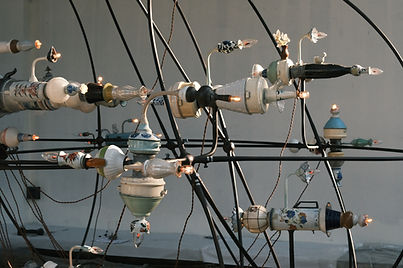
Torlarp’s works give form to this intrinsic desire for connection. Earlier works, such as Spiritual Spaceship (2018) and The Spiritual Station (2023), explored migration, technological progress and the enduring value of belief and memory. The spaceship is not just a vessel for space exploration; it is a medium that carries stories and connects past and present. By incorporating found objects and everyday materials into his installations, Torlarp harnesses the memories and experiences embedded in these objects for his storytelling endeavours. While rooted in specific cultural references, his works resonate on a more universal register, speaking across cultures, generations and geographical borders.
Cosmos of Nostalgia brings multiple dimensions into conversation: the artist’s multicultural imagery and the layered histories of its surroundings. Torlarp describes this work as one where “viewers will feel as though they are entering an inner world of the past, one filled with fantasy, dreamlike visions and stories that connect the outer universe and inner imagination.” The installation’s interior features intricate paintings that draw on imagery, philosophy and myths from Thai and Chinese cultures. Visual motifs from 20th-century Thai science fiction, early science encyclopaedias, Chinese philosophy and mythology are interwoven into a hybrid lexicon. The visual style employed in the paintings is influenced by traditional Chinese shan shui (山水) landscape paintings and murals found in Thai temples. This sweeping panorama of rivers, mountains and skies pays tribute to Taoist philosophy and the grandeur of nature.
The artist regards his works as a form of “moving architecture” that engages in close dialogue with the environment and audience. Viewers can enter and witness this imaginary world merge with its immediate surroundings. The character of Wan Hu appears, attempting to ascend to outer space and cross the threshold between dream and reality. The work offers viewers the opportunity to do likewise by climbing to the upper chamber of the installation. Here, they are enveloped by a bare, unpopulated landscape where they become characters in this fictional world, participating in a communal act of storytelling. Through a constellation of myth, memory and history, Cosmos of Nostalgia bridges the earthly and the cosmic, a forgotten past and an imagined future. Stepping into this spaceship-like time capsule, we too become space explorers, collaborating in an unfolding narrative where history speaks into the present.
This article is written by curator Lu Xiaohui for On the cusp (2026), and presented in partnership with NTU Museum, Singapore.
On the cusp, presented by NTU Museum, is on view at various locations around Nanyang Technological University, Singapore, from 21 January to 2 April 2026.


Space Station,2023
How many worlds Are we at JIM Thopmson Art Center
BKK, Thailand
20 July - 29 October 23
The space station represents both a shelter for space travellers and a vehicle between the past and the future. It navigates a world where distance is relative to time and human progress continues further and further from the past each second. It speaks of memories that live on, leaving traces and holding a symbolic connection to be remembered in thoughts and in the ordinary objects passed down from one generation to the next.
While this station serves as a centre of dreams and an ambitious pathway to discover a far-reaching meaning for humanity, simultaneously, it allows us to take pause and look back at where we came from through the vaguely familiar yet foreign shape of an unconventional future world where memories return us to our origin


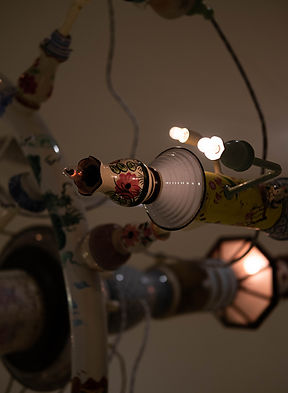


Voyager(Prototype),2022
Out of this World Exhibition
MOCA Museum of Contemporary Art
Exhibition Period: June 5 - July 10, 2022


Insignificant Meaningful
Taiwan Contemporary Culture Lab, Taipei Taiwan
Exhibition Period: 4 October - 8 December 2019

Insignificant Meaningful
Esplanade Concourse, Singapore
Exhibition Period: 19 April - 14 July 2019

Article by Jirat Prasertsup
The ark of Torlarp Larpjaroensook
From his grandmother’s spiritual spaceship to a memory-filled Noah’s ark
The term “collage art” is frequently used to designate two-dimensional works of art, often a montage of photographs, paintings or drawings. For such a reason, Torlarp Larpjaroensook finds it an ill-adapted label when it comes to discussing his practice. However, if you mention to him the phrase “collage sculpture”, he will be more than pleased to talk you through his works, which involve the assemblage of miscellaneous objects and materials into three- dimensional structures.

Bangkok Art Biennale 2018
Spiritual Spaceship (installation) for Bangkok Art Biennale 2018
Exhibition Period: 19 October 2018 - 3 February 2019

U.S.O.
“I - solated Beings” (installation) at Subhashok The Arts Centre, Bangkok, Thailand
Exhibition Period :17 March – 22 April 2018

The U.S.O., also known as the Unidentified Standing Object, was converted from an old water tank. It is habitable and is able to be transported into new environments to create connections and share its experience in relations to the surrounding. Its identity is defined by the context and environment it is located: it may be referred to as a tent in the middle of the woods; a temporary shelter for a construction site; a sculpture inside an art gallery; or it could simply be an old, abandoned water tank from an apartment, depending on how the viewers place its values.

Naturally, as humans, we all need ‘safety’.
Beyond the skin that envelope and the clothes that wrap us, we build shelter to protect ourselves from danger.


We all have our own world, beliefs and dreams. The outlook of the U.S.O. may seem like a strange object as though it came from another planet, yet at the same time it builds a new experience and connecting its alienated self and the personal space (inside the U.S.O.) with the public space (outside of the U.S.O.).
“We are each other’s aliens”, therefore differences are not the things to be feared of.

AIR BORDER series
This project begins with combination of ideas, firstly the idea that related to climate similarity between countries are located in tropical world zone. Secondly, the idea of new experimenting paint which affected by natural cause.


Artist is just a part of painting process because completion of art relies on uncontrollable natural phenomenon as well. We, as human nature, are all shar- ing the same climate even though reside in different country. The thing such a border line would in fact be illusion, as we are all facing terror of those uncon- trollable natural phenomenon.
Technique: By using whether chart of tropical world zone during storm period as a painting outline then bending steel wired along those lines on the can- vases. The paintings are left outdoor for the Sun, air, rain and other natural phenomenon to oxidize those wires and give a result with new rusty image that effect on the existed colors.

The journey of switchhead


%20%26%20Veena%20Girl(Holdy)4_J.jpg)
History - Bestto Boy is a switch light, made in an eletronic factory located in the suburb area of Osaka. One day, the factory was hit by a big thunder storm . After that, Bestto boy and his brother were splashed away.
Present-Bestto Boy is resurrected. He was again found in an eletrical supply shop in Chiang Mai - Hang Dong Road, Chiang Mai,Thailand.
Since then,Bestto boy has the phobia for thunder. Bestto like fishes but scared of water. Bestto Boy is confused whether he is AC or DC.

